
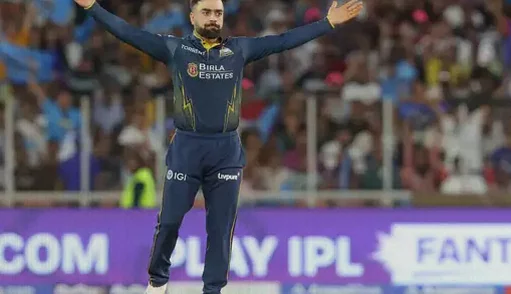
Rashid Khan is entering his 10th season in the IPL, a journey that once made him synonymous with elite T20 leg-spin. The Afghanistan spinner says he has not been operating at the same level as he did for most of the previous seven years, but insists form can swing quickly in cricket. His view is simple: “You have good days and bad days. Sometimes you have a bad month or even a year.”
Quick facts
- Rashid Khan is playing his 10th IPL season.
- He says his impact in the last two seasons has not matched his earlier seven-year stretch.
- He believes the team’s slow start is linked to finishing close games rather than overall control.
- He says Gujarat Titans are still working hard and expect to bounce back in the next match.
- Rashid expects more high totals if teams bowl poorly, but lower scores if the bowling unit executes.
- He argues spin’s value hasn’t disappeared; it depends on hitting the right areas consistently.
- He notes earlier seasons brought him fewer than 17 wickets was not a trend, but the last two years delivered 10 and 9 wickets.
- He says short-term struggles for spinners (including Varun Chakaravarthy and Noor Ahmed) can reverse quickly.
In the conversation, Rashid began with a question on Shubman Gill’s status and answered that the opener is doing well and should be available for the next match, adding “Inshaallah”. He then assessed Gujarat Titans’ early campaign, saying the start was not ideal but also that the team had actually been in positions to win.
Rashid pointed out that two of their games were decided by narrow margins, yet they failed to close them out strongly. He said the side managed to control roughly 35–36 overs across those contests, but the final two or three overs did not swing in their favour. The message from his perspective is that the group has taken lessons from those finishes and will move forward with stronger intent in the next game.
Captaining in front of 80,000-plus
Asked what it feels like to lead a team in the IPL with close to 80,000 spectators in attendance, Rashid described it as a major honour. He said captaining in one of the world’s biggest leagues is “more than a proud moment” and highlighted how the role is an additional layer of learning for him as a player.
He noted that a decade ago he never imagined playing in the IPL, and now being in the leadership group provides opportunities to be part of discussions and grow. Rashid also said he genuinely enjoyed the experience because it is “something very special” to captain in front of such a crowd.
Looking ahead, Rashid said there is nothing fundamentally different in how he views the season for Gujarat Titans or the league itself. He said the team has trained hard, is in a good frame of mind, and while the side had a difficult beginning, it has still played good cricket overall.
Rashid expects the tournament to follow its usual pattern, with the same franchises competing for the trophy and pushing hard every day. He suggested Gujarat Titans are aiming for a strong run across their remaining matches, targeting better performances with full strength and the right mindset while ensuring they give “100 percent” effort on the field, regardless of outcomes.
Why 200-plus totals keep showing up
Rashid also discussed why the IPL has been leaning towards bigger scores. He argued that if bowlers go off their plans, runs will flow, but if they execute well, high totals become harder to chase. In his view, it comes down to both individual skill and how the bowling unit performs together.
He said good bowling should produce lower totals, while poor bowling can even allow sides to reach around 400. For him, the day-to-day effectiveness of the bowling group is the deciding factor, not just pitch reputation or past trends.
On the broader debate of batters dominating bowlers, Rashid agreed that in the last two or three years batters have approached scoring with a different mindset. Still, he believes teams can’t overthink it—if batters are set with the belief and the plan to hit in the right areas consistently, the scoreboard usually reflects it.
He added that conditions may favour hitters, but execution remains the real separator. As long as bowlers keep the correct mindset and stick to their plans, he believes it does not have to be impossible to manage scoring pressure.
Spin’s “life” and the off-spinner question
Rashid rejected the idea that the lifespan of spinners—especially leg-spinners and mystery spinners—has become difficult in a permanent way. He said it can feel tougher if a spinner is not producing the level of turn that unsettles batters, or if they are not beating hitters or taking wickets in the way they used to. But he maintained that this does not happen often, and that consistent bowling to the right areas will bring positive results.
He also responded to the claim that coaches advise batters to play spinners as off-spinners so they can neutralise googlies. Rashid’s position is that an off-spinner is still a bowler, and a batter’s tactics do not change the fundamentals of his role—landing balls in the right zones consistently.
He explained that when a ball does not grip and turn, the batter can treat the delivery as coming straight, which can reduce the impact. But if the ball does spin, the situation changes, and mindset becomes central. He pointed to Harbhajan Singh and Ravichandran Ashwin as examples of elite off-spinners who have taken wickets, including hat-tricks, proving the class of spin is not confined to one style.
Rashid then clarified his own approach: he is a leg-spinner, so if the ball turns, he will spin it. If it does not, the ball will come straight to the batter—either way, his job is to deliver in line with what the conditions allow.
His evolution over 10 seasons
When asked about his personal evolution across his decade in the IPL, Rashid addressed the statistical contrast. He acknowledged that he has never had fewer than 17 wickets in a season earlier, but in the last two campaigns he took 10 and 9 wickets. He also referenced economy-rate changes, saying his numbers were below 7 earlier, while the last three seasons have been above 8—particularly in the final two years.
Rashid said that a year ago he still got around 10–11 wickets, but he believes the context matters because the team played fewer matches, with some games washed out. He suggested that if those two or three additional matches had been completed, he could have added another 6–7 wickets, putting him closer to a 17–18 wicket season.
He stressed that performance cannot be judged only by headlines, and that his current mindset is the most important element. Rashid repeated that good and bad stretches are part of the sport, and said what happened in the past is gone—right now he feels energetic and is looking forward to the season.
On who has been difficult to bowl to over the years, Rashid said he does not categorise batters as simply good or bad. He argued that there is no fixed label; if a bowler bowls poorly, anyone can be targeted. For him, the key is focusing on his own line and length and bowling into the right areas, without letting fear or assumptions about a batter’s strength disrupt his execution.
He summarised it as keeping things straightforward: bowl a good length, hit the right areas, and manage the match-up through repeatable bowling skills rather than trying to predict how a batter will behave.
Varun, Noor and the “mystery spinner” debate
Rashid then spoke about how mystery spinners do not seem as effective lately, naming Varun Chakaravarthy and Noor Ahmed. He said it is not helpful to overreact to one or two matches, because spinners can have both strong starts and rough stretches, and a brief run does not automatically mean a permanent change in quality.
He pointed out that Noor’s earlier form last season did not necessarily define his overall ability, and similarly Varun has bowled well across years, meaning isolated results are not proof of a sudden shift. Rashid added that cricket can swing for anyone at any time, and used a recent example from his own league: in the team’s last game, Ravi Bishnoi of Rajasthan Royals took four wickets, showing that spinners can still dominate.
In that context, Rashid argued leg-spinners and mystery spinners are not “out of fashion”. If they bowl in the right areas, the results will come—maybe not on the same day, but soon enough.
When asked directly about Varun Chakaravarthy, Rashid said he would ask him personally during a meeting and then share what happened from that perspective.
With Gujarat Titans having suffered two defeats from their first two games, Rashid concluded by advising the team to take matches one at a time and focus on performing for the group. He reminded that the franchise has enjoyed four strong seasons already, and said they are aiming to carry that momentum into this year as well with a successful campaign.
