
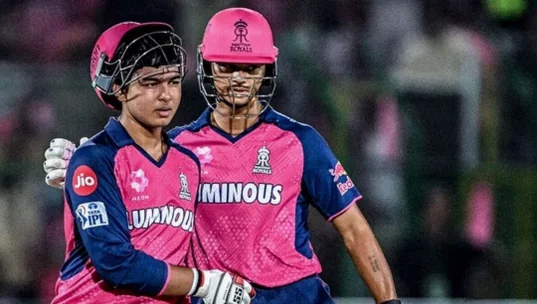
Rajasthan Royals’ opening duo in the 2026 IPL has produced a storyline few would have predicted at the start of the campaign. Vaibhav Sooryavanshi, a teenager already turning heads, has amassed 583 runs across 14 matches. His partner at the top, Yashasvi Jaiswal, has scored 397 runs from the same number of appearances—figures that fall short of the lofty expectations placed on the senior India Test batter.
With Jaiswal established as the more experienced name and a consistent presence in the national setup, most observers expected him to outscore his partner, if not dominate the batting order outright. Instead, Sooryavanshi has not only matched the hype—he has exceeded it, and that shift in momentum has been noted even by one of the Royals’ key mentors and thinkers, Ravichandran Ashwin.
Ashwin’s view on Jaiswal’s dip and Sooryavanshi’s rise
Ashwin suggested that Jaiswal’s returns feel slightly below what his talent level promises. He pointed out that Jaiswal’s run total is lower than in each of the previous four IPL seasons. While Rajasthan Royals still have at least one match left in the season—an Eliminator meeting with Sunrisers Hyderabad scheduled for Wednesday—Ashwin believes Jaiswal still has work to do to close the gap.
More than the numbers, however, Ashwin addressed the possibility of a psychological swing within the batting partnership. In his words, the impact of Sooryavanshi’s fearless performances may have unsettled Jaiswal’s rhythm.
“It is slightly underwhelming, and I am a bit surprised by Yashasvi Jaiswal’s performance in the Rajasthan Royals team. I am a little surprised because I expected a lot from him; I have high hopes. But I just have a slight inkling of a feeling that Vaibhav Sooryavanshi’s display has perhaps shaken Jaiswal a bit. It has rattled him,” Ashwin said on his YouTube channel.
The Sehwag–Chopra parallel
Ashwin then drew a comparison to an earlier chapter from India’s Test era—when Virender Sehwag and Aakash Chopra opened together. Chopra made 10 Test appearances for India, including his debut against New Zealand in 2003. But during the Border-Gavaskar Trophy tour of Australia, Chopra’s approach of protecting one end did not fully register because Sehwag’s aggressive style overwhelmed the opposition and changed the complexion of the batting.
According to Ashwin, a similar pattern may be emerging in the Royals’ current top-order dynamic: Sooryavanshi’s intensity could be influencing how Jaiswal chooses to bat, especially in matches where early wickets and pressure situations force decisions.
“If you remember the opening pair of Virender Sehwag and Aakash Chopra in Test matches, Aakash Chopra used to play really well, giving good starts of 30 or 40 runs. But the sheer style and manner in which Virender Sehwag batted used to make Aakash Chopra look almost invisible. Not that he was; Aakash Chopra did a great job on that Australian tour too. But I just have a feeling that because of Vaibhav Sooryavanshi’s fierce batting here, it has thrown Jaiswal off a little. In many games, Jaiswal got out trying to hit the ball too hard,” Ashwin added.
What Ashwin expects next
Ashwin reiterated that he wants to see Jaiswal succeed because the batter clearly has the ability to do so. Still, he acknowledged that Rajasthan Royals’ season narrative has increasingly centered on Sooryavanshi, whose performances have become a defining feature of the franchise’s batting identity.
He also referenced a key moment of execution in the season—when Jofra Archer was needed, he stepped up. Yet, Ashwin still framed the broader context with a note of concern for other parts of the league, claiming that Mumbai Indians have been “very, very, very, very underwhelming” this season and that the particular target being chased was achievable.
For Rajasthan, the Eliminator against Sunrisers Hyderabad now represents an opportunity to reset and finish strongly—while Jaiswal looks to rediscover the consistency that made him one of the most dependable top-order threats in the competition.
