
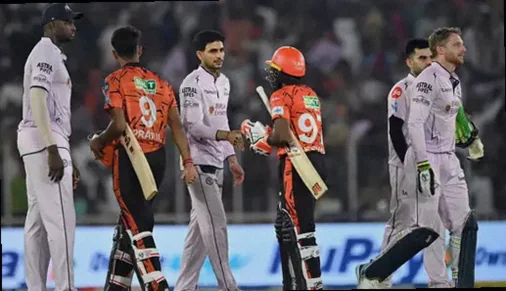
Sunrisers Hyderabad head coach Daniel Vettori backed his batters despite a devastating top-order collapse that left the side stranded on 86 as Gujarat Titans defended 168 to earn a record-margin win in the IPL on Tuesday, May 12. Vettori called the result a rare misfire for a batting unit that has largely thrived through an ultra-aggressive brand of cricket, insisting the team would not be deluding itself about how it has been performing “and on the surface”.
Vettori on the collapse and why he still trusts the batting group
Speaking after the match, Vettori said Sunrisers knew they needed a strong start and simply did not deliver it on the night. He stressed that if the opposition had posted a much higher total, the chase would have been nearly impossible, but felt the 169 target should have kept SRH in contention.
- Vettori said SRH’s batting order has generally been exceptional this season, describing the collapse as a short, unusual setback rather than a change in quality.
- He noted that “every team” experiences small blips in a long campaign, adding that SRH’s came in this particular game.
- He argued that while the team understood the need to begin well, it “wasn’t able to do” so, and that was the decisive factor.
- He said that because the Titans’ final score was 169, Sunrisers believed they had a chance—yet they failed to start effectively.
- Vettori maintained there was no blame to place specifically on the batting unit, given their overall output across the season.
How Gujarat defended 168 and what made the chase different
Gujarat Titans successfully defended 168, which was both the second-lowest total they have defended this season and the lowest context in which Sunrisers suffered their biggest defeat by runs in IPL history. The contest also differed from many recent IPL games in that it did not unfold as a Powerplay-focused batting duel.
- Gujarat’s 168 proved enough to beat SRH by runs, delivering the franchise’s record win over Sunrisers in the league.
- The match featured only 68 runs in overs 1 to 6, which was tied for the joint-lowest Powerplay aggregate for the season.
- That meant the early phase was not defined by big hitting from either side, but rather by control and pressure from the Titans.
Sai Kishore’s pitch assessment and praise for the Titans’ approach
For Gujarat, Sai Kishore suggested the target felt close to par. He said 170 was a reasonable number on a wicket that was “a little damp” and offering notable seam movement, and he pointed out that the way his side batted made the surface “look much better than what it was”.
- Kishore said the pitch conditions—dampness and seam—made it a different kind of challenge.
- He added that the Titans’ batting approach helped make the wicket appear more favourable than it actually was.
- He described Sai Sudharsan’s contribution as a “wonderful innings,” even while acknowledging that Sudharsan was not striking at an especially high rate on that specific wicket.
- Nishant Sindhu was also credited for showing “intent” during the middle overs, helping maintain momentum beyond the early stage.
Powerplay bowling blueprint: Test-match lengths and tactical flexibility
Kishore said the game was largely shaped by how Gujarat’s seamers operated in the Powerplay, extending the team’s strong record of new-ball bowling this season. He highlighted the effectiveness of the unchanged bowling partnership between Kagiso Rabada and Mohammed Siraj during that opening burst.
- Kishore pointed to Rabada and Siraj as the most productive new-ball pair of the season.
- Together, they captured 21 wickets in the Powerplay when bowling from the start with unchanged roles.
- He said both Rabada and Siraj have been hitting their lengths very well, calling it a key advantage.
Kishore then connected that success to the influence of Test cricket skills within the squad. He credited Shubman Gill and Ashish Nehra for guiding Gujarat’s bowling philosophies, particularly in deciding what lengths to use in the Powerplay. On a wicket where hard length delivery mattered more than relying heavily on slower balls or yorkers, he said the Titans trusted the “hard length” and “good length” they were able to land repeatedly.
- Kishore said having genuine Test-match bowlers in the lineup made a “huge difference” across the season.
- He credited Gill and Nehra for setting the bowling philosophy, especially around Powerplay length selection.
- He explained that on this kind of wicket, Gujarat trusted hard and good-length bowling rather than depending too much on slower balls or yorkers.
Even so, Kishore insisted Gujarat are not locked into one plan. He argued the bowlers can switch gears when the pitch is placid and when they face sides capable of ultra-aggressive batting.
- Kishore said bowlers like Rabada, Prasidh, Siraj, and Holder are all capable of delivering yorkers and slower balls.
- He said that when there is plenty of purchase in the surface, the key is to be brave and bowl hard lengths.
- When the pitch is calmer, he believes Gujarat will smartly shift to yorkers, slower balls, and slow bumpers to get through an over efficiently.
- He added that Gujarat have played many matches on similar types of wickets this season, which is why they have continued to stick with Test-match bowling.
