
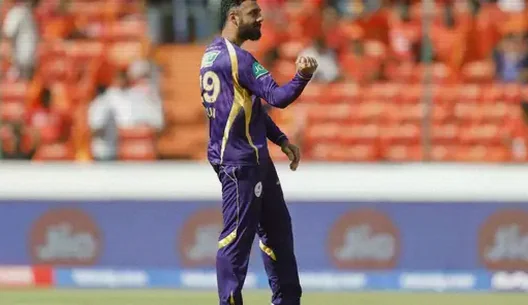
After starting IPL 2026 with six consecutive defeats, Kolkata Knight Riders have put their campaign back on track with three straight victories. Much of that turnaround has been driven by their specialist spin partnership of Sunil Narine and Varun Chakaravarthy, who have combined to claim 13 wickets in the latest three matches at a strike rate of 11.07 and an economy rate of 6.8. Their performance in Sunday’s match against Sunrisers Hyderabad underlined just how strongly the duo can swing results: KKR restricted SRH to 165, even after the chase looked well within reach at 105/1 in the ninth over. The confidence created by Varun and Narine’s control has been a recurring feature for KKR in recent seasons, and it’s helped the side find a winning rhythm when batting inconsistencies have threatened to derail their momentum.
Varun’s rise has been especially significant for KKR’s progress. His form has come after a relatively quiet beginning to the season and a period earlier in the year when he wasn’t at his best in national colours. If the view is widened beyond IPL, Varun had taken 11 wickets in nine T20I matches for India since January, maintaining an economy rate of 10.29 while also missing two games due to a wrist injury. In IPL 2026 specifically, his first three appearances yielded 0/105 from nine overs, and the lack of impact early on was noticeable. However, since then he has changed the complexion of games, picking up 10 wickets at an economy of 7.31, with eight of those wickets arriving in KKR’s three wins. In two of those victories, he was named Player of the Match, a reflection of how his breakthroughs have often arrived at the moments that matter most.
One of the key reasons his returns have improved is the timing of when he is brought into the attack and how that shapes his matchups. In T20Is for India across 2024 and 2025, his powerplay record stood out, with eight wickets at a strike rate of 16.25 and an economy of 6.84. In 2026, though, that early overs impact has dipped, with him taking three wickets at 22.33 while the run rate climbed to 9.57, including a figure of 10.66 against full member teams. In his opening IPL 2026 outings, he also struggled with the new ball, producing 0/40 in two overs, with Rohit Sharma punishing him at Wankhede and Abhishek Sharma doing the same in the home fixture. Since returning to form and settling into KKR’s role, the earliest he has typically been introduced has been the eighth over, and his usage has been heavily weighted toward the middle phase—15 of his 16 overs have come after the powerplay. That pattern has allowed him to operate when batters are searching for rhythm rather than attacking freely from the start; he even bowled the 18th over in a tied finish against LSG, taking the crucial wicket of Ayush Badoni.
Against Rajasthan Royals, Varun’s spell was built on accuracy and length control. His figures of 3/14 came in four overs, including 2/7 from the 14 balls he faced at a good length. All three of his wicket-taking deliveries were bowled in the 96–99 kmph range, showing how consistent pace and execution helped him find dismissals. In the game versus Lucknow Super Giants, the story was slightly different: it was about reacting quickly after being hit. After conceding a six by Nicholas Pooran over long-on, Varun adjusted by shortening his length and pushing it further wide. The change forced the batter into a catchable position at short third-man, with three fielders stationed in the ring behind point specifically to support that dismissal pattern. Badoni, who often goes for the lofted drive over extra cover against spin, was cramped by the angle from around the wicket, leaving him short of room for his usual release shot.
Against SRH, Varun’s first two overs had cost 29 runs, yet they still included an important breakthrough: Travis Head, who struck 61 off 28, was removed during that phase. The next over sequence tightened the screws. After Head had deposited a six over long-off on the previous ball, Varun responded by rushing him for space, increasing his pace by 10.6 kmph to 104.8, and then getting Head caught at deep mid-wicket. The “googly” threat was also visible—10 of them in his first two overs cost 24 runs—but the latter part of his spell was more efficient, with only two runs coming from the nine deliveries in the final two overs. That sting helped him take another wicket, dismissing Smaran Ravichandran with a ball that beat him for length and carried into the air; the delivery arrived at 92.7 kmph, and the contact didn’t come cleanly enough to prevent a wicket.
While KKR’s bowling offers a clear pathway to competitiveness, their batting issues have been evident across the tournament. Their combined top-order average of 21.65 is the lowest among the 10 teams. Even when they are able to get starts, the tempo hasn’t been consistently sharp—KKR’s strike rate of 141.45 is only better than Lucknow Super Giants’ 134.63, and both are far below the broader tournament numbers of 34.36 and 166.62. In a format where the top order often decides the standings and the outcomes, KKR’s struggles with the bat have been a recurring challenge. Yet as the tournament moves deeper into its business end, their spin duo remains the clearest source of hope, with Narine and Varun consistently turning pressure into wickets and keeping KKR within striking distance of victory.
