
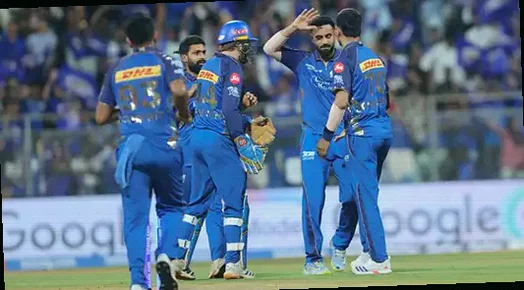
Mumbai Indians’ IPL journey has long been powered by timing—arriving when it matters, tightening their grip as the season moves deeper. This year, that spark never arrived. A last-ball thriller against Royal Challengers Bengaluru on Sunday, May 10, ended MI’s playoff hopes as they fell by two wickets, even with three league fixtures still remaining. For a franchise that has often felt synonymous with steadiness and big-game certainty, the result completes a sixth consecutive campaign without a title and leaves yet another season drifting away from the summit.
Jayawardene’s verdict after the RCB defeat
What stood out after the loss was not a search for excuses, but a blunt appraisal of the team’s shortcomings. Mahela Jayawardene did not hide behind factors such as luck, scheduling, or conditions. Instead, he highlighted how often MI had been given chances, only to fail to turn them into results.
“Yeah, I mean, the season, it’s disappointing. We’ve had our opportunities. We were not good enough. We were not consistent enough with the ball, with the bat and that showed the margins,” Jayawardene said after the defeat.
His comments landed because Mumbai’s season has repeatedly been decided by fine margins. MI have not looked overwhelmingly inferior to the rest of the competition, yet they have repeatedly lost moments that carried the biggest weight. The pattern continued on Sunday in Raipur, where defending 166 pushed them into the final over—but not over the line.
Jayawardene also reflected on how narrow the difference between contention and elimination has been. “We were probably two, three wins away from being in the same group of contenders to get into that playoff. But we didn’t get those wins and today was another classic example that we were short,” he said.
Even with the scoreboard suggesting they were close, the narrative from the match and the campaign was similar: MI often created the platform, but failed to sustain the level long enough to finish.
How the game slipped away
- Mumbai set out to defend 166, with the match staying alive for long stretches as they kept pressing.
- They looked poised to go beyond the 166-mark they eventually posted, but momentum was disrupted in the middle overs.
- Naman Dhir’s dismissal came at a moment when Naman and Tilak Varma appeared ready to accelerate.
- As the innings progressed, MI again showed they could not fully convert their late-innings opportunities into a bigger total.
- Jayawardene pointed to the 14–15 over phase as a turning point where two wickets fell, including Will Jacks going out just before the timeout—an outcome he described as avoidable.
- With those setbacks, the ceiling of the chase became tighter, and ultimately MI fell just short in the final over.
Jayawardene summed up the theme after the game: “We knew 170-180 was a good score. And we were heading towards that. And we lost again another couple of wickets in that 14-15 mark. Naman getting out. And then [Will] Jacks getting out as well just before the timeout. So those were a couple of unforced mistakes during that time.”
Inconsistency across departments
The defeat served as another illustration of a broader campaign issue—MI’s inability to lock into a consistent rhythm across both innings. At different stages, parts of the side have performed, but rarely everything has clicked together. Their bowling has suffered from lapses in control during crucial phases, particularly near the end of matches. On the batting side, MI have often depended on individual bursts rather than maintaining collective control.
Even when they appeared positioned for a better outcome, the finishing overs repeatedly revealed the same problem: they could not maximise their chances when the game demanded it most.
Team changes, injuries and the “forced” nature of rotation
Beyond on-field execution, MI’s season has also been shaped by availability. Rohit Sharma spent a substantial portion of the early campaign on the sidelines. Hardik Pandya’s fitness concerns emerged at a key stage, and Mitchell Santner also missed time due to injury disruptions. The franchise ultimately used 24 players in the tournament—more than any other side—while Delhi Capitals and Lucknow Super Giants were next with 21 each. The sheer number reflects how difficult it became for MI to settle into a stable combination.
Yet Jayawardene resisted the idea that Mumbai’s troubles were largely self-inflicted through excessive tinkering. “I don’t think it was chopping and changing,” he insisted. “We had a lot of injuries, a lot of niggles, guys getting injured, not available, some players were not there as well. So, that was mostly was forced changes. Tactically, we would have changed few, very few during the season. I would have loved to have our main core guys consistently being out there.”
He added that, even with disruptions, excuses are not a substitute for performance. “But there’s no excuses. I think we had a quality squad. It’s just that, like I said, we had to put our hand up and say that we were not good enough overall.”
Trust in the core—and what it revealed this year
That honesty ties into how MI have traditionally operated. Over the years, the franchise has leaned on experience and continuity, choosing not to overhaul the structure after a run of poor results. Even as questions grew around the form of some senior players during this season, Jayawardene made clear the management continued to believe in the group that has previously carried the team through title cycles.
There is logic in that loyalty: MI’s most successful eras were built on stability and trust in a core unit. But this season has also exposed the risk of that approach when the collective does not deliver at the required level. Suryakumar Yadav has struggled to find consistent impact, while Hardik Pandya has endured a quieter campaign with both bat and ball. MI backed experience in the hope of a rediscovery of form, but a full turnaround never truly arrived.
Jayawardene addressed the mindset behind that decision. “No, I don’t think it is. They’re also trying to do their best. If I knew that it was something to do with that, I would have spoken to them. But the commitment, the effort that they’re putting in is unbelievable. So I was quite determined,” he said.
He pointed to Rohit Sharma’s commitment after returning from injury as an example of why the management continued to place faith in their senior players. “With Ro (Rohit Sharma) getting injured and coming back and batting the way he batted, it sums up. I mean, the core group is quite valuable for us. You can’t just keep changing. We went with the trust, the confidence that we had with them. And then it is what it is. Like I said, it’s difficult for me to go beyond that. They had a really good World Cup, winning it and all that. So I think it’s just that as a unit, we haven’t been good enough.”
The transition challenge after elimination
With the playoff door now closed, MI are facing a transition that feels different from the usual cycles of rebuilding. The core that once propelled them through championship phases is no longer producing at the same collective standard. Mumbai Indians are not in collapse, but they increasingly appear suspended between preserving a winning nucleus and constructing the next one.
Even after elimination, Jayawardene suggested it was too soon to conduct a full diagnosis of what went wrong. “It’s difficult for me to sum up a season right now. I have to give it some thought as well and then figure out exactly (what went wrong).”
Still, the outline is already visible. MI stayed close often enough to remain within touching distance, yet inconsistency prevented them from ever fully convincing. They lost tight games, failed to close key moments, struggled to keep their best players available, and never found the collective sharpness that once defined them. With three matches still left to play, Mumbai are already left looking at another season that does not end the way they want.
