
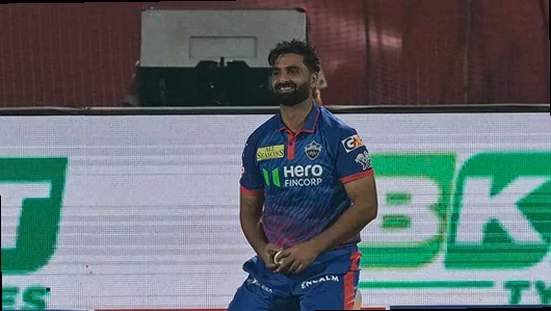
Auqib Nabi marked his return to the Delhi Capitals’ playing XI against Punjab Kings with a spell that looked far more comfortable than his recent outings. The venue in Dharamsala played a significant role in that, because the surface and conditions leaned towards pace. In that kind of setup, Auqib’s ability to land a disciplined length and follow a clean bowling line becomes a major weapon, and it carried echoes of the Ranji Trophy days when similar wickets helped him rise to prominence. On Monday night, the 29-year-old essentially did what was required: bowl with intent, stick to the plan, and make the most of a pitch that was already doing the work for fast bowlers.
Coming into the match, his form had been under scrutiny. In each of his previous three appearances, he had been hit at an economy rate of 13.43, which was a tough pill for a bowler being talked about as a potential next big name in Indian cricket. Against Punjab Kings, though, Auqib made amends quickly. It was encouraging to see him get past the bat of Priyansh Arya and Prabhsimran Singh repeatedly, while even Shreyas Iyer appeared to respect his control and chose his moments carefully rather than going after everything.
Even so, it wasn’t a perfect performance. Auqib ended up delivering two no-balls, and for a T20 side, those are costly mistakes—because the format rarely leaves room for even one slip. After conceding 12 runs in his opening over, he responded with a noticeable correction in his lengths and variations. In his next three overs, he gave away 8, 2 and 10 runs respectively, and several deliveries looked genuinely troublesome for the batters, suggesting the confidence was back where it mattered.
The only glaring gap was the wicket column. Despite the pressure he created, he still hadn’t taken his first IPL wicket. That means the positives from his comeback spell are clear, but there is still a long way to go. There are also clear improvements he can target to turn a promising spell into a match-turning one.
Fitness, pace and the next steps
Auqib’s workload and impact will likely depend on two key areas: fitness and pace. First, he needs to get leaner. The example of Anshul Kamboj is a useful reference point—there was a time when Kamboj looked considerably heavier during a Test outing in England last year, and his movement and effectiveness suffered as a result. This year, however, he has been a revelation for Chennai Super Kings and has emerged as a serious contender for the Purple Cap. It’s not common in cricket history to see fast bowlers thrive while carrying extra weight, so Auqib can benefit from that same kind of transformation after the IPL.
Second, he must add speed. At present, his quickest deliveries are above 130 kmph, but stepping up at the international level—and even consistently at IPL intensity—requires him to push that higher. For guidance, he can look at Bhuvneshwar Kumar’s evolution. Early in his career, Bhuvneshwar was known mainly as a swing bowler with limited pace, yet over time he developed the ability to run in and hit higher speeds, with seasons in the IPL where he repeatedly clocked above 140 kmph. That acceleration helped him remain relevant and effective, even as conditions and competition changed.
For now, Auqib can take confidence from how he responded despite heavy scrutiny. This is his first IPL campaign, and after dealing with criticism, he has at least shown that he can recalibrate quickly when the conditions suit him. He will be eager to note what worked in Dharamsala and carry it into his next outing. When he returns again, the expectation will be that he not only bowls with control, but also converts pressure into wickets—and gives his critics something harder to question.
